Montenegro is a small country, but its table is vast. Shaped by centuries of Ottoman influence, Slavic pastoral tradition, Adriatic seafood culture, and the resourcefulness of mountain communities who had to survive long winters on what they could preserve and store — the food of Montenegro and the wider western Balkans is one of the most distinctive and underappreciated culinary traditions in Europe.
At our eco estate, my mother Vesna prepares meals that have passed through four generations of our family. Nothing is sourced from a supplier. Everything comes from the garden, the village, or the nearby hills. This post is our attempt to share some of that knowledge — not as a formal cookbook, but as an invitation to understand what you're eating and why it tastes the way it does.
The Building Blocks: Dairy
No ingredient is more central to highland Montenegrin cooking than dairy — specifically kajmak and domaći sir.
Kajmak is a thick, slightly fermented clotted cream made by slowly heating fresh milk and then allowing the cream layer to form on the surface. The cream is skimmed and layered with salt in wooden barrels, where it ages and develops a complex, slightly tangy richness. Young kajmak (mladi kajmak) is mild and spreadable; aged kajmak (stari kajmak) is firmer, more intense, and has a character closer to a soft cheese. There is no adequate translation and no adequate substitute. It is eaten on bread, stirred into polenta, melted over grilled meats, and consumed at almost every meal in a highland household.
Domaći sir — homemade cheese — is made throughout the highland zones of the Balkans in dozens of regional variations. In the Bjelasica area, the most common version is a fresh white cheese made from cow's or sheep's milk, pressed in cloth, and eaten within days. Aged versions are stored in brine or smoked over pine needles. The flavour ranges from mild and milky to sharp and almost chalky — depending on the milk, the season, and the maker's hand.

Njeguški Pršut: Montenegro's Greatest Charcuterie
Njeguški pršut is Montenegro's most celebrated food product — a dry-cured, cold-smoked ham from the mountain village of Njeguši on the slopes of Mount Lovćen. It has been made in the same way for at least four centuries, and the combination of the coastal bora wind (which dries the meat) and the pine smoke (which flavours and preserves it) creates a product with a taste that is entirely its own. Slightly smokier and less sweet than Italian prosciutto, denser and more intensely flavoured than most Spanish jamón — it occupies its own category.
The best njeguški pršut is dry-aged for a minimum of twelve months, during which it loses nearly half its original weight. The resulting meat is deep ruby-red, with white fat that melts on the tongue and a smoke perfume that lingers pleasantly on the palate. It is typically eaten thinly sliced with kajmak and bread — a combination so simple and so perfect that it needs nothing else.
"The first time a guest tries njeguški pršut with our homemade kajmak, they usually go quiet. That silence is the best compliment." — Vesna
Lamb and Meat: The Tradition of Slow Fire
Lamb is the prestige meat of the Montenegrin highlands, and the preparation methods reflect a culture that valued patience and communal eating.
Jagnjetina ispod sača (lamb under the bell) is perhaps the most iconic Balkan cooking technique. The sač is a heavy cast-iron or terracotta bell — a dome that is placed over the meat, covered in glowing embers and ash, and left for three to four hours. The result is meat of extraordinary tenderness, with a crust on the outside and a juicy interior that requires no carving knife, only fingers. The same technique is used for bread (hljeb ispod sača), vegetables, and fish along the coast.
Jagnjetina na ražnju — spit-roasted lamb over an open beech-wood fire — is the other great expression of the same animal. A whole lamb, seasoned only with salt, turning slowly for four or five hours over wood embers. The skin crisps and chars while the interior remains pink and fragrant. Served at celebration meals, family gatherings, and the best highland restaurants, it represents the simplest and most honest form of mountain cooking.
Vesna prepares traditional meals for guests throughout the summer season — dishes made from our own garden produce, local cheese, and ingredients sourced directly from neighbouring village families. Ask us about arranging a traditional dinner when you book.
Polenta, Kačamak, and the Grain Dishes
Kačamak is the soul food of the Montenegrin highlands. Made by cooking coarse cornmeal in salted water until it thickens to a dense, pulling mass, then beaten vigorously with generous quantities of kajmak and sometimes fresh cheese — it is the definition of highland winter comfort. The word "kačamak" comes from Turkish, and the dish entered Montenegrin cuisine during the Ottoman period, quickly becoming so embedded that it is now inseparable from the national food identity.
Good kačamak is hard physical work to make. The polenta must be stirred constantly to prevent lumps, then beaten with wooden paddles until it reaches the right elastic texture. The kajmak is added in stages, each addition worked in by hand. In our family, kačamak is made the same way my grandmother made it — in a large copper pot, on a wood fire, with enough kajmak to make a doctor wince.
Cicvara is a related dish — essentially polenta cooked slowly in butter and kajmak from the beginning, rather than beaten in at the end. The result is richer and creamier, almost like a porridge. Typically eaten for breakfast or as a mid-afternoon meal, cicvara is found across Montenegro, Serbia, and Bosnia, with each region claiming its version as the original.
Soups, Stews, and One-Pot Meals
Pasulj (bean stew) is the everyday staple of Balkan cooking — made in every household, eaten every week, never boring when done properly. The foundation is dried white beans, slow-cooked with onion, smoked meat (bacon, smoked ribs, or dried lamb), paprika, and bay leaves. In the highland version, the beans are cooked longer, the broth is thicker, and the smoked meat component is more dominant. Served with fresh bread and pickled peppers, it is a complete and deeply satisfying meal.
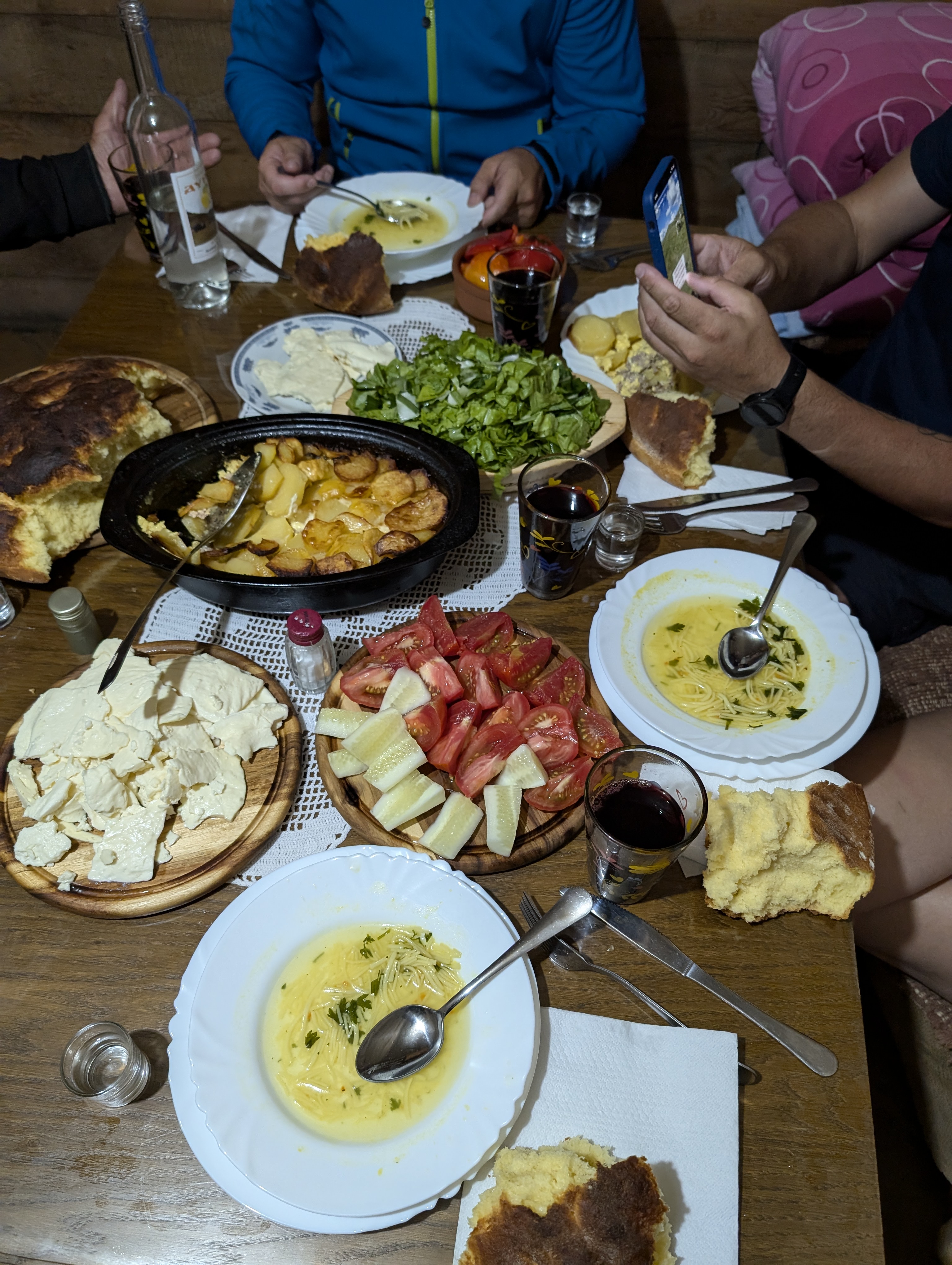
Čorba is the general Balkan term for a hearty, meat-based soup. Lamb čorba, made with the less noble cuts of a young sheep — neck, ribs, shoulder — cooked with root vegetables, egg yolk, and a splash of lemon juice, is the great restorative dish of mountain cooking: rich, deeply flavoured, and warming in a way that no restaurant soup can quite replicate.
Bread: The Staff of Life
In Montenegrin highland culture, bread is not a side item — it is the meal's foundation. Proja (cornbread, sometimes made with cheese or kajmak baked in) is the most distinctly Balkan expression of this. Dense, slightly crumbly, with a golden crust and a faintly sweet interior, proja is eaten at every meal, used to scoop up stews and soups, and consumed cold with cheese the next morning.
Somun — a round, slightly leavened flatbread of Ottoman origin — is made throughout the Balkans but particularly in the areas with a longer history of Ottoman settlement, like the northern Montenegro lowlands. Baked in a wood-fired oven or under the sač, it has a thin charred crust and a soft, slightly chewy interior.
Priganice are small fried dough balls, dusted with sugar or served with honey and kajmak. They are a tradition at celebrations, wakes, and gatherings of all kinds — the Balkan equivalent of a doughnut, but lighter and less sweet, fried fresh and eaten immediately. Vesna makes them for guests on special mornings, and they disappear very quickly.
Sweets and Preserves
The Balkan sweet tradition is heavily Ottoman-influenced. Baklava — layers of filo pastry, walnuts, and sugar syrup — is made throughout the region, with the best versions from Sarajevo and Foča widely acknowledged as among the finest in the world. In Montenegro, baklava is a celebration sweet, made for Eid, Christmas, weddings, and the arrival of important guests.
Tufahije are poached apples stuffed with walnuts, sugar, and spices, served cold with whipped cream — a Bosnian speciality that has spread throughout the region. Hurmašice are soft, honey-syrup-soaked semolina cakes, shaped like small dates (their name means "little dates" in Turkish), found at every baker across the Balkans.
The highland tradition also includes extraordinary fruit preserves (slatko) — wild berries, sour cherries, rose hip, and cornelian cherry (drijen), cooked slowly with sugar to thick, jewel-like concentrations of flavour. Served on a tiny spoon alongside Turkish coffee to an arriving guest, slatko is the ultimate expression of Balkan hospitality.
Rakija: The Spirit of the Balkans
No account of Balkan food culture is complete without rakija — the fruit brandy that is, across the entire region, the social lubricant, the after-dinner ritual, the medicine, the gift, and the expression of hospitality. In Montenegro, the most common versions are lozovača (grape), šljivovica (plum), and kruškovača (pear), but the category is vast — quince, cornelian cherry, apricot, honey (medovača), and combinations of all of the above.
Good rakija is distilled twice, aged in wood or kept in large glass demijohns, and consumed from small glasses at room temperature. In the highlands, the morning rakija (jutarnja rakija) is a genuine tradition — a small glass taken before breakfast, especially on cold mornings or the first day of a hard job. It is offered to guests as automatically as coffee.
Making rakija at home is legal in the Balkans and almost universal in rural communities. Watching the distillation process — the careful management of the fire, the temperature of the cooling water, the discarding of the "head" and "tail" fractions — is as interesting a cultural experience as visiting any museum. If you stay with us at the estate, we will show you how it is done.
Balkan coffee — domaća kafa or turska kafa — is made by simmering finely ground coffee in a small copper pot (džezva) until it froths, poured with the grounds into small ceramic cups, and drunk slowly. It is served with a glass of water and, in households, with something sweet. Never rush a Balkan coffee. It is not a caffeine delivery mechanism — it is a conversation.
Where to Eat Well in Northern Montenegro
The best food in northern Montenegro is almost always found in private homes, family-run restaurants (domaća kuhinja), and highland estate kitchens — not in resort hotels or tourist-facing establishments. Look for places where the menu is short (if there is a menu at all), where the owner is also the cook, and where the ingredients are named by village rather than brand. When a server tells you "the lamb is from our neighbour's farm" or "the cheese is from the katun above the village" — that is where you should eat.
At our eco estate in Ravna Rijeka, Vesna prepares meals during the summer season using produce from our own garden and ingredients sourced directly from the farming families of our village. It is simple, seasonal, and as honest as food gets. We do not have a menu — we cook what is good that day, and we share it the way our family has always shared food: around a common table, with time.